Saint Jerome: Scholar of Scripture and Translator of the Latin Vulgate
Enter the world of one of the greatest biblical minds of Late Antiquity, whose mastery of languages and relentless dedication to the sacred text shaped the Latin Bible and the intellectual tradition of Western Christianity.
The historical and theological transition of the fourth century from a persecuted minority to an imperially favored and institutionally powerful Church found one of its most articulate, combustible, and learned representatives in Eusebius Sophronius Hieronymus, known to the Western tradition as Saint Jerome. Few figures of Late Antiquity embody so vividly the tensions of their age. Jerome stands at the point where Roman classical education, Christian asceticism, doctrinal controversy, and biblical philology converged. He belongs fully to the late Roman world, yet his influence reaches far beyond it, shaping medieval monasticism, Western biblical culture, and later humanist scholarship. If Augustine became the great architect of Latin Christian theology, Jerome became its most relentless textual laborer and its fiercest philological conscience.
Jerome occupies a singular position among the Latin Fathers because he was not merely a translator, monk, or controversialist in isolation. He was all three at once. His greatest fame rests on his role in the making of the Latin Bible later known as the Vulgate, but his importance extends beyond that monumental achievement. He was a vigorous advocate of ascetic renunciation, an interpreter of Scripture who brought unusual linguistic range to his work, a prolific correspondent whose letters illuminate the social and devotional life of late Roman Christianity, and a biographical writer who helped define a Christian literary memory of the past. His life, stretching from approximately the middle of the fourth century to 419 or 420 AD, moved across the major cultural centers of the Mediterranean world: provincial Dalmatia, the schools of Rome, the ascetic circles of northern Italy, the Syrian desert, Constantinople, and finally Bethlehem.
To study Jerome is therefore to study more than one man. It is to observe the remaking of Christian intellectual life in an age when the Church was consolidating doctrine, negotiating authority, defining scriptural norms, and absorbing the educational inheritance of pagan antiquity. Jerome was often abrasive, sometimes unfair, and rarely moderate, yet his severity arose from convictions that were intellectually serious and spiritually costly. He believed that Scripture demanded exacting study, that holiness required renunciation, and that truth could not be served by pious vagueness. His life reveals the power and peril of a mind determined to subordinate all things, including literary elegance and social approval, to the service of sacred learning.
The Formative Years: Stridon and the Roman Education
The origins of Jerome are rooted in the borderlands of the late Roman world. He was born around 347 AD at or near Stridon, a town located between Dalmatia and Pannonia, though its exact site remains uncertain. What is clearer than the geography is the social world from which he emerged. Jerome belonged to a family of means, one capable of financing the advanced education necessary for public and intellectual distinction. His background was provincial rather than metropolitan, but it was not humble. He grew up within the horizons of the Roman landed class, where education functioned as both ornament and instrument of advancement.
Later sources and devotional retellings sometimes attempt to fill in details of his family, but the evidence is uneven. What can safely be said is that Jerome was raised in a Christian household, though not one defined by early monastic rigor. His youth was shaped less by intense catechetical formation than by the expectations of Roman respectability and literary cultivation. That pattern was common among fourth-century Christians of means. Christianity had become socially visible enough that one could grow up within it and yet still be formed primarily by the curriculum of classical elite culture.
Jerome was sent to Rome for higher study, probably in adolescence. This move was decisive. Rome was not merely the political capital of the West; it remained a center of Latin education, rhetoric, and literary prestige. There Jerome studied under the famous grammarian Aelius Donatus, whose name alone signals the quality of the training he received. The grammatical schools of the late Roman world were not superficial institutions. They trained memory, syntax, diction, interpretation, and stylistic imitation through close engagement with canonical authors. Jerome learned not only to read Latin but to inhabit it with unusual force.
The Curriculum of Aelius Donatus and Its Lasting Impact
The education Jerome received under Donatus was a classic instance of Roman paideia. Students read and parsed authors such as Virgil, Cicero, Terence, and Sallust, learning not only vocabulary and grammar but the architecture of persuasive and beautiful prose. Jerome absorbed these authors deeply. Their rhythms, turns of phrase, and rhetorical energies became part of the texture of his mind. Even when he later rebuked himself for excessive love of pagan eloquence, he never ceased to write as a man profoundly shaped by it.
This training explains much about Jerome’s later work. His translations are not the productions of a merely devout interpreter; they are the labor of someone trained to hear the pressure of words, clauses, and sentence movement. His letters, prefaces, and polemical treatises display an instinct for contrast, irony, invective, and verbal precision that would have been impossible without a thorough rhetorical formation. Unlike some Christian writers who adopted a deliberately plain style, Jerome never relinquished the habits of classical literary consciousness. He wrestled with them, distrusted them, redirected them, but he never ceased to possess them.
During these Roman years he also encountered law and dialectical reasoning, whether formally or through the broader educational atmosphere. His later controversial writings show a legal sharpness in argument, a fondness for citation, and an ability to cross-examine opponents through textual detail. Jerome was not simply a monk with books. He was a classically trained intellectual who later placed those tools at the service of the Church.
| Educational Phase | Location | Primary Focus | Principal Influence |
|---|---|---|---|
| Early schooling | Stridon region | Basic literacy, discipline, household formation | Local tutors and family setting |
| Grammar and rhetoric | Rome | Classical Latin authors, syntax, style, rhetoric | Aelius Donatus |
| Legal and philosophical exposure | Rome | Argument, jurisprudential habits, ethical reasoning | Urban intellectual milieu |
| Early theological study | Trier | Christian reading, copying, patristic engagement | Works of Hilary of Poitiers and emerging ascetic ideals |
Despite his academic success, Jerome’s student years in Rome were marked by moral and spiritual turbulence. In later recollection he portrayed himself as having lived with too much frivolity, indulgence, and vanity, though his autobiographical style often heightens contrast for moral effect. Even allowing for rhetorical exaggeration, it is clear that his Roman years exposed him both to high culture and to the anxieties of a conscience not at peace. He described visiting the catacombs and the tombs of martyrs on Sundays, moving from the pleasures of elite student life to places marked by death, silence, and judgment. That oscillation between literary ambition and penitential fear would never fully disappear from his character.
Baptism and the Awakening of Monastic Interest
Around 366 AD, near the end of his Roman formation, Jerome was baptized by Pope Liberius. This sacramental act was not the beginning of his Christianity in a social sense, but it did mark the start of a more serious spiritual reorientation. After Rome he traveled with his friend Bonosus into Gaul and eventually spent time in Trier, one of the great imperial centers of the West. Trier mattered because it was there, under Christian imperial conditions, that Jerome appears to have moved more decisively from cultural Christianity to intellectual discipleship.
In Trier he began serious study of Christian authors, including works of Hilary of Poitiers. He copied texts, read more intensely, and encountered the growing prestige of the ascetic ideal in the Latin world. The influence of Athanasius’s Life of Antony was spreading westward, and with it the fascination with desert renunciation as the highest form of Christian commitment. Jerome found himself deeply drawn to this model. From this period onward, scholarship and asceticism would no longer be separate impulses in his life. They would increasingly reinforce one another.
It is in this connection that later admirers speak of Jerome beginning to build a kind of “library of Christ.” The phrase is evocative rather than technical, yet it captures something real. Jerome did not imagine holiness as the abandonment of study. He imagined study transfigured into service. Books were not ornaments to him; they were instruments of conversion, controversy, and scriptural understanding.
The Ascetic Odyssey: Aquileia and the Syrian Wilderness
By about 370 AD, Jerome had returned to northern Italy and joined an ascetic circle in Aquileia associated with Bishop Valerian. This group included figures such as Tyrannius Rufinus, who at that stage was a friend and fellow spiritual seeker rather than an enemy. Aquileia represented an early western attempt to bind educated Christians into communities of discipline, prayer, and study. It was not yet the fully developed monasticism of later centuries, but it embodied the growing conviction that serious Christian life required structures of renunciation and fraternity distinct from the ordinary patterns of Roman domestic and civic life.
The Aquileian phase was brief, but important. It gave Jerome direct experience of communal asceticism and showed him both its promise and its fragility. The circle eventually dissolved, likely because of tensions internal and external, including personality conflicts and ecclesiastical pressures. Jerome’s restlessness then drove him eastward. If Italy could offer a taste of disciplined Christian life, Syria and Palestine appeared to offer its original and more radical forms.
His eastern journey took him through Thrace and Asia Minor to Antioch, one of the most important Christian cities of the East. There he suffered illness and the loss of companions, and there too he underwent one of the defining experiences of his life: the famous vision in which he appeared before the divine tribunal and heard the accusation that he was not a Christian but a “Ciceronian.” Whether treated as literal vision, spiritual crisis, or rhetorical memory, the episode reveals the depth of his internal war. Jerome feared that literary culture had become not merely a tool for him but a rival allegiance.
The Hermit of Chalcis and the Origins of Hebrew Study
In response to this crisis, Jerome withdrew to the desert of Chalcis, southwest of Antioch. The desert, however, did not function as a romantic landscape of instant sanctity. In Jerome’s own descriptions it was a place of fierce bodily weakness, loneliness, and mental conflict. He fasted, prayed, and attempted to subdue what he called the rebellion of the flesh, but he also discovered that the imagination does not obey geography. Even in solitude he remained haunted by memory and desire.
It was here that Jerome undertook the study of Hebrew. This step was one of the most consequential in the history of Western biblical learning. In the Latin West, Greek itself was already becoming less common among educated clergy; Hebrew was rarer still. Jerome turned to a Jewish teacher, possibly a convert or at least someone willing to instruct him, and began the arduous process of learning the language of the Hebrew Scriptures. He famously complained that Hebrew seemed harsh, sibilant, and resistant to his Roman ear. Yet he persisted.
What began as an exercise in penance became an intellectual vocation. Hebrew study disciplined him, humbled him, and gave him access to a textual world that most Latin Christians knew only through the Septuagint or older Latin renderings. In time this would produce his doctrine-like preference for the Hebraica veritas, the “Hebrew truth,” by which he meant the primacy of the Hebrew text for establishing the Old Testament in Latin. That shift would make him both revolutionary and controversial.
| Aspect of Desert Life | Experience in Chalcis | Long-Term Significance |
|---|---|---|
| Physical discipline | Fasting, austerity, isolation | Deepened commitment to ascetic self-mastery |
| Psychological conflict | Temptation, memory, inner agitation | Destroyed idealized notions of easy holiness |
| Intellectual activity | Copying manuscripts, studying Hebrew | Prepared the future translator of Scripture |
| Ecclesiastical pressure | Doctrinal and factional disputes among eastern Christians | Strengthened Jerome’s instinct for Roman ecclesial unity |
Jerome’s stay in Chalcis ended not simply because of hardship but because the desert itself was entangled in theological conflict. The East of the late fourth century was riddled with disputes over Trinitarian language, episcopal legitimacy, and the rival claimants to major sees, especially Antioch. Jerome found the situation exhausting and appealed to Pope Damasus I, presenting Roman communion as a criterion of certainty amid doctrinal chaos. When no immediate resolution came, he withdrew from the desert and returned to Antioch. The experience left an enduring mark: it confirmed his mistrust of factionalism and helped ground his later respect for Roman doctrinal centrality.
From Antioch to Constantinople: The Scholarly Ascent
Back in Antioch, Jerome’s reputation had grown. He was ordained priest by Paulinus of Antioch around 378 AD, though he appears to have accepted ordination on terms that preserved his ascetic independence. He had no desire to become a routine parish administrator. Jerome was a priest-scholar, not a pastoral organizer by temperament.
From Antioch he moved to Constantinople, probably around 379 or 380, where he studied under Gregory Nazianzen. This period was decisive for his Greek formation. If Rome had made him a master of Latin eloquence and the desert had pushed him toward scriptural asceticism, Constantinople widened his intellectual horizons by exposing him to the great Greek theological tradition in a living form. Gregory offered him not only doctrinal instruction but a model of Christian literary seriousness shaped by Greek rhetoric and contemplative theology.
Jerome’s time in Constantinople also brought him into contact with Origen’s exegetical legacy. He translated several Greek works into Latin, including homilies of Origen and the Chronicon of Eusebius of Caesarea, which he continued to the year 378. These translations show Jerome already acting as a mediator between East and West. He was not merely importing ideas; he was constructing a Latin intellectual vocabulary capable of carrying the weight of Greek Christian scholarship.
Jerome was in Constantinople around the time of the Council of 381, though it is more precise to say that he was present in the city and its theological orbit than to insist with certainty that he participated as a formal conciliar actor. What matters is that he stood close to the center of doctrinal consolidation in the post-Nicene world. His exposure to Gregory Nazianzen, Gregory of Nyssa, and the wider eastern theological elite gave him both confidence and range for the work he would later undertake in Rome and Bethlehem.
The Roman Secretariate and the Papal Commission
In 382 AD, Jerome returned to Rome in connection with a synod dealing with the Antiochene schism. There he entered the service of Pope Damasus I, who quickly recognized his unusual value. Jerome’s linguistic skills, theological competence, and forceful mind made him a natural advisor and secretary. This Roman period placed him at the center of ecclesiastical administration and gave him the opportunity to exert influence at the highest level of the western Church.
The most consequential result of this relationship was the biblical commission that would define Jerome’s historical legacy. The Latin biblical text in the fourth century was unstable. What modern scholars call the Vetus Latina was not a single translation but a family of earlier Latin versions, often diverging substantially from one another. This textual plurality had liturgical, interpretive, and doctrinal consequences. Damasus wanted a more reliable and standardized Latin Bible, and Jerome was the obvious candidate for the task.
It is important, however, to describe this task accurately. Jerome was first commissioned to revise the Gospels, not to produce at once a wholly new Bible in final form. His work began as a revision of existing Latin texts in light of Greek manuscripts. Only later, especially in Bethlehem, did the project expand into the broader and more daring program that posterity associates with the Vulgate. The Vulgate, in other words, is the result of a layered textual history, not a single act of translation executed in one place and time.
The Evolution of the Vulgate Project
Jerome’s initial Roman revision of the Gospels was conservative. He corrected the Old Latin text where the meaning had been obscured or where Greek evidence demanded alteration, but he did not begin by overturning every familiar phrasing. This caution reflects both pastoral prudence and textual realism. Christian communities do not easily surrender words that they already know by heart.
He also worked on the Psalms. The first revision, later associated with the Roman Psalter, was based on the Septuagint tradition. A later revision, often connected with the Gallican Psalter, drew more heavily on the Hexaplaric Greek tradition and in some sense moved closer to Hebrew. Jerome eventually also produced a translation of the Psalms iuxta Hebraeos, from the Hebrew itself. These multiple Psalter forms are important because they demonstrate that Jerome’s biblical method developed over time. He did not begin at maximum radicalism. He moved gradually from revision within received tradition toward source-based retranslation.
| Bible Component | Earlier Jerome Phase | Mature Jerome Phase | Historical Outcome |
|---|---|---|---|
| Gospels | Revision of Old Latin against Greek | Stabilized Latin Gospel text | Core Jerome contribution to NT |
| Psalms | Roman Psalter from Septuagint tradition | Gallican Psalter and Hebrew-based version | Multiple Jerome-associated Psalter traditions |
| Old Testament | Some early revision work from Greek | Major Hebrew-based translations in Bethlehem | Most historically transformative stage |
| Rest of New Testament | Possibly minor Jerome influence in parts | Largely older Latin transmission retained | Not all directly Jerome’s work |
One of the most important corrections to popular summaries of Jerome is precisely this point: he did not personally translate the entire New Testament in the form later printed as the Vulgate. His direct and secure work there is strongest for the Gospels; the rest of the New Testament reflects older Latin texts, perhaps with some degree of revision, but not a straightforward Jerome-authored total translation. That distinction is essential for accuracy.
The Aventine Circle and the Advocacy for Virginity
Jerome’s Roman years were not defined by textual work alone. He also became the spiritual guide of a remarkable circle of aristocratic women committed to ascetic Christianity. Meeting around the house of Marcella on the Aventine, this group included Paula, Blaesilla, and Eustochium. Jerome taught them Scripture, guided their devotional reading, and encouraged forms of renunciation that stood in sharp contrast to the values of Roman elite domestic life.
This circle was socially and theologically significant. It reveals the extent to which ascetic Christianity had become attractive to members of the aristocracy, especially women seeking an alternative to the expectations of marriage, display, and dynastic ambition. Jerome’s relationship with these women was intellectually serious. He wrote to them with exegetical depth, moral urgency, and often with a level of candor unusual in male-female correspondence of the ancient world.
Yet the very intensity of these relationships also generated suspicion. Jerome made enemies through his attacks on clerical luxury and through his exaltation of virginity. Letter 22 to Eustochium, on the preservation of virginity, became one of the most influential texts of Christian asceticism in the Latin West. It also sharpened resistance to him. When Blaesilla died after severe ascetic practices, public anger rose against Jerome, who was blamed in hostile circles for encouraging excess. The death of Damasus in 384 stripped him of protection, and by 385 he left Rome under pressure, scandal, and slander.
The Bethlehem Settlement and the Hebraica Veritas
After leaving Rome, Jerome traveled east again, accompanied in effect by the loyalty and material support of Paula and Eustochium. After pilgrimage in Palestine and a visit to Egyptian monastic centers, the group settled in Bethlehem in 386. There Paula financed a monastic complex consisting of a monastery for men, several houses for women, and a hospice for pilgrims. Bethlehem became Jerome’s home for the rest of his life and the site of his most daring work.
It was here that Jerome’s preference for the Hebraica veritas fully matured. The phrase does not simply mean that he liked Hebrew. It signals a methodological conviction: when establishing the Old Testament for the Latin Church, the Hebrew text should be primary, not the Greek Septuagint alone. Jerome did not deny the immense importance of the Septuagint, nor did he treat it as worthless. But he judged that it did not always preserve the textual form that a translator seeking proximity to the Hebrew Scriptures should follow. This view was radical because the Septuagint had long been authoritative in Christian usage, theology, and exegesis.
Jerome’s preference for the Hebrew text was not a naïve antiquarianism. It arose from years of linguistic study, consultation with Jewish teachers, and dissatisfaction with the state of older Latin versions. He wanted the Latin-speaking Church to have access to Scripture in a form more rigorously grounded in its original language. This was at once a scholarly judgment and an ecclesial gamble.
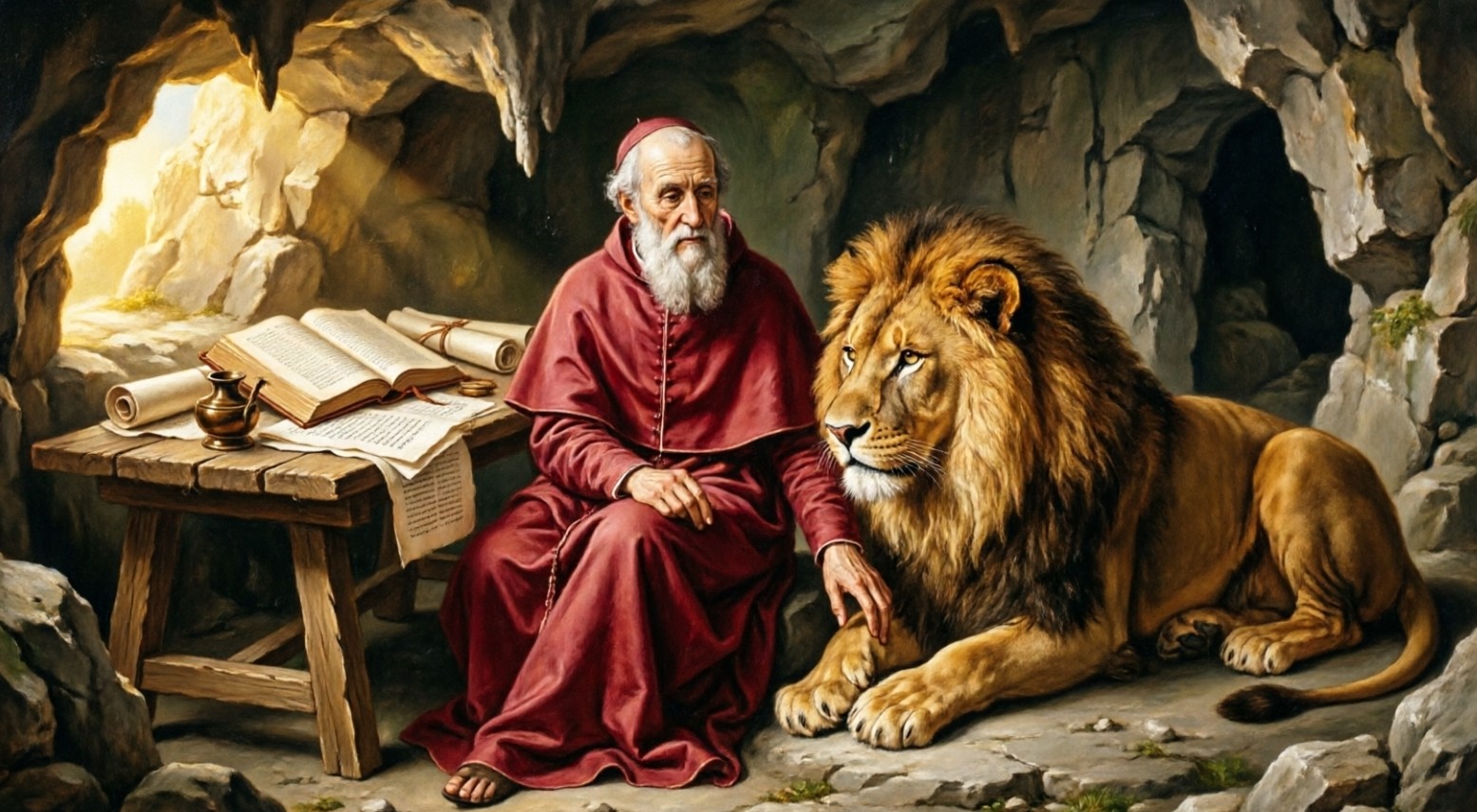 The story goes that while living as a hermit near a monastery in Bethlehem, St. Jerome encountered a lion with a thorn in its paw. While the other monks fled, Jerome calmly removed the thorn. The lion became his loyal companion, living in the monastery and guarding a donkey used for hauling firewood.
One day, the lion fell asleep while watching the donkey, and some passing merchants took the donkey away. When Jerome discovered the lion, he assumed it had eaten the donkey. As punishment, he assigned the lion the donkey’s chore of hauling wood. Later, the merchants returned, and the lion recognized the stolen donkey, scaring the men into fleeing. The grateful merchants confessed their theft. Jerome then realized the lion was innocent, and the lion continued living faithfully beside him until Jerome’s death.
The story symbolizes redemption, gentleness, and taming one’s wilder nature. It became a popular medieval legend, often depicted in art with Jerome (a scholar and Bible translator) accompanied by a lion.
The primary source of this legend is The Golden Legend
[1].
The Translation of the Hebrew Bible
Beginning around 390 AD, Jerome launched into direct translation of much of the Hebrew Bible into Latin. This work extended over many years and required intense collaboration and consultation. He used Jewish teachers and informants, compared textual traditions, and defended his choices in prefaces that are themselves masterpieces of learned polemic. He translated with a concern for both accuracy and intelligibility. Jerome never embraced a wooden literalism for its own sake. He sought fidelity, but as a trained rhetorician he also cared about intelligible Latin.
His sources and methods were more varied than simple slogans suggest. For the protocanonical books of the Old Testament, Hebrew was the primary base. For Tobit and Judith, Jerome himself says he worked from a “Chaldaean,” that is, Aramaic text or tradition, though the textual history of those books is complicated. The additions to Daniel were associated with Greek traditions such as Theodotion. The additions to Esther and other deuterocanonical materials remained bound to Greek and older Latin transmission. The Vulgate that later dominated the West was therefore not a uniform product but a composite Bible in which Jerome’s Hebrew-based translations stood alongside other materials transmitted from Greek or earlier Latin sources.
| Jerome’s Source Base | Primary Language | Representative Result |
|---|---|---|
| Hebrew Bible | Hebrew | Most of Jerome’s mature Old Testament translation |
| Chaldaean or Aramaic tradition | Aramaic | Tobit and Judith in Jerome’s account |
| Greek textual tradition | Greek | Daniel additions, Esther additions, some inherited materials |
| Old Latin tradition | Latin | Much of the non-Gospel New Testament in later Vulgate form |
Jerome’s preference for Hebrew provoked serious resistance, especially from Augustine. Augustine worried that if Latin translations diverged from the Septuagint familiar in the churches, ordinary believers would be confused and the bond between Greek and Latin Christian interpretation would weaken. Jerome answered that fidelity to the scriptural source required courage. Their exchange reveals one of the deepest tensions in Christian intellectual history: whether ecclesial stability should rest primarily on received liturgical tradition or on renewed return to original texts. Both men were serious; neither was trivial. Augustine defended usage and unity, Jerome defended philological exactness.
Jerome also developed habits of layout and commentary meant to aid readers, including per cola et commata presentation in some contexts, which helped signal sense-units of the text. This concern shows that his scholarship was not merely antiquarian. He wanted the Latin Church not only to possess a more exact Bible but to read it more attentively.
The Theological Wars: Polemics and Controversies
Jerome’s Bethlehem years were not calm years of monastic translation alone. They were also years of theological war. Jerome’s temperament was intensely combative, and his pen could be devastating. He was never content merely to differ; he often sought to defeat, expose, and shame opponents. This trait damaged friendships and sometimes distorted his fairness, but it also made him a formidable defender of positions he believed essential.
Adversus Jovinianum and the Hierarchy of Merit
In 393 AD, Jerome wrote Adversus Jovinianum against the Roman monk Jovinian, who argued that baptized Christians shared equal merit before God regardless of whether they lived in virginity, widowhood, or marriage. Jerome viewed this thesis as a direct assault on the ascetic hierarchy that was increasingly central to late fourth-century Christian spirituality.
His response was rhetorically extreme. Virginity becomes gold, marriage silver. Renunciation is exalted; matrimony is defended only with reserve. Jerome appealed to biblical imagery, including the thirtyfold, sixtyfold, and hundredfold fruits, as though they established graded levels of Christian perfection. The treatise was influential, but also embarrassing in places even to sympathizers. Jerome’s exaltation of virginity sometimes led him to formulations that sound dismissive of marriage itself. He later had to defend the harshness of his own defense.
Yet the broader historical effect of the treatise was immense. It helped solidify in the Latin West the superiority of celibate and renunciatory vocations in the Christian imagination. Whatever moderating theological correctives later writers supplied, Jerome’s intervention ensured that monastic and virginal ideals would remain central to western ecclesiastical culture for centuries.
The Origenist Controversy and the Rift with Rufinus
The most painful controversy of Jerome’s life centered on Origen and on his former friend Rufinus. Both men had once admired Origen as a giant of Christian learning. Jerome in particular had absorbed much from Origen’s exegetical method and had translated some of his homilies. But as suspicions mounted around Origen’s speculative theology, including teachings associated with the pre-existence of souls and final restoration, Jerome moved decisively toward public opposition.
The crisis exploded in 398 AD when Rufinus translated Origen’s Peri Archon into Latin and implied continuity with Jerome’s earlier admiration. Jerome recoiled. Concern for his orthodoxy, personal pride, and real doctrinal alarm combined to produce a bitter war. He responded by translating Origen more literally in order to expose what he judged dangerous passages that Rufinus had softened. The exchange permanently destroyed their friendship and helped turn a scholarly relationship into an ecclesiastical scandal.
This controversy matters for more than personal biography. It illustrates the late antique process by which earlier theological giants could be selectively received, domesticated, or condemned as ecclesial boundaries hardened. Jerome’s shift from admiration to denunciation may seem inconsistent, but it reflects the broader instability of an age still deciding how much speculative freedom Christian theology could bear. The controversy eventually drew in Roman authorities, including Pope Anastasius, and contributed to the narrowing of acceptable theological discourse regarding Origenist themes.
The Final Battle: Against Pelagianism
Jerome’s last major struggle was against Pelagius and the movement associated with him. Pelagian theology emphasized moral responsibility and the capacity of the human will in ways that Jerome regarded as dangerously minimizing the damage of sin and the necessity of divine grace. By the time Jerome engaged the controversy, he was an old man, but not a softened one.
In the Dialogus contra Pelagianos of 415, Jerome argued from Scripture and theological tradition that fallen humanity cannot achieve righteousness by autonomous effort. Here Jerome stood close to Augustine, though Augustine remains the far more systematic thinker of grace. Jerome’s contribution was less architectonic and more combative. He provided biblical ammunition, rhetorical energy, and ecclesiastical support for the anti-Pelagian cause.
Violence followed. Jerome’s monastic establishments at Bethlehem were attacked in the context of the Pelagian disturbances, and buildings were damaged or burned. The precise social and political mechanics behind the attack are more complex than a simple slogan about “Pelagians did it,” but the link between the controversy and the violence is real enough. Jerome endured not merely literary opposition but physical danger in his final years.
The Epistolary Legacy and Historical Works
Jerome’s literary greatness cannot be reduced to his biblical translation. His surviving letters, numbering over a hundred, rank among the richest documentary remains of Late Antiquity. They range from brief notes to near-treatises, covering exegesis, moral counsel, doctrinal dispute, grief, friendship, patronage, monastic guidance, and ecclesiastical strategy. Through them Jerome appears not as a statue but as a living and highly volatile personality.
The letters are especially valuable because they bring together different registers of Jerome’s mind. They show the ascetic director writing to noble women, the exegete explaining difficult passages, the controversialist lashing out at opponents, and the aging monk reacting to events such as the sack of Rome in 410. For historians, these letters are a gold mine. They map networks of influence, reveal patterns of patronage, and show how theology circulated socially, not just institutionally.
De Viris Illustribus and the Christian Memory of Learning
In 392 AD, Jerome composed De Viris Illustribus, a work of short biobibliographical notices on 135 Christian authors from apostolic times to Jerome himself. The work was modeled on earlier classical literary collections, especially Suetonius-like precedent, but Jerome repurposed the genre for Christian apologetic ends. He was not inventing biography as such; rather, he was Christianizing a literary form and placing Christian writers within an honorable historical lineage. That distinction matters. To call him a “pioneer in biographical history” without qualification is too broad, but he was certainly an influential adapter of classical bio-bibliographical tradition for Christian self-understanding.
The purpose of De Viris Illustribus was strategic. Pagan critics sometimes treated Christianity as intellectually thin or derivative. Jerome responded by showing that the Church possessed a lineage of learned writers worthy of literary respect. In doing so, he helped define a Christian canon of memory: a usable past of authors, books, and doctrinal labor. The work’s medieval influence was enormous because it offered later readers a map of Christian literary inheritance.
| Jerome’s Major Historical or Biographical Works | Approximate Date | Purpose or Content |
|---|---|---|
| Chronicon | c. 380 | Latin continuation of Eusebius’s world chronicle to 378 |
| De Viris Illustribus | 392 | Biobibliography of Christian authors |
| Vita Pauli | c. 376 | Hagiographical portrait of Paul the Hermit |
| Vita Hilarionis | c. 390 | Life of the Palestinian monk Hilarion |
| Vita Malchi | c. 391 | Narrative of captivity, chastity, and monastic identity |
Monastic Leadership and the “Library of Christ”
Jerome’s Bethlehem monastery was more than a retreat. It was a working center of scholarship. Books were acquired, copied, compared, excerpted, and deployed. Assistants and scribes were involved in production. Patrons funded the material base. Letters carried questions and answers across long distances. In this sense, Bethlehem under Jerome functioned as a kind of proto-research community. It did not resemble a modern academy, but it did embody a disciplined environment in which texts were central, comparison mattered, and learning served ecclesial ends.
One should be careful not to make unverifiable numerical claims about the exact size of Jerome’s library. The image of an immense collection is plausible and traditional, but precise totals remain uncertain. What is certain is that Jerome lived among books and treated them as instruments of holiness. He rebuked ignorance fiercely because he regarded scriptural study as a spiritual necessity, not a luxury. His famous dictum, often quoted in paraphrase, that ignorance of Scripture is ignorance of Christ, captures the whole orientation of his life.
Jerome’s asceticism also shaped the intellectual ethos of the monastery. Study was not a leisure activity detached from prayer. It was an extension of conversion. Textual labor became a spiritual exercise, a training of the mind in reverence and exactitude. This integration of monastic discipline and textual production profoundly influenced later western monasticism. Medieval scriptoria did not begin with Jerome, but Jerome supplied one of the great precedents for the idea that monastic communities should preserve, transmit, and interpret sacred texts with disciplined care.
The Reception of Saint Jerome: Carolingian and Renaissance Perspectives
Jerome’s posthumous reputation evolved over time. In Late Antiquity he was admired, but his personality also limited the universality of his appeal. Over the centuries, however, different ages discovered in him what they most needed. The Carolingian reformers valued him as a model of textual seriousness. Under rulers and scholars seeking liturgical and textual uniformity, Jerome’s work on the Bible became newly central. The process of correcting and standardizing the Latin Bible in the early medieval period, associated especially with figures such as Alcuin of York, did not create Jerome’s authority, but it helped institutionalize it. By then the Vulgate had become the backbone of western biblical culture.
In the Renaissance, Jerome was reborn yet again, this time as a patron saint of philology and learned reform. Erasmus especially admired him, seeing in Jerome a fusion of classical learning, linguistic depth, and Christian seriousness. Erasmus’s edition of Jerome’s letters helped restore him to the center of patristic study and aligned Jerome with the humanist ideal of returning to the sources. This was a fitting development. Jerome himself had been, in his own fourth-century way, a source-minded scholar who challenged comfortable habits of textual transmission.
The history of the Vulgate also continued beyond Jerome. Its text circulated in multiple forms, accumulated scribal corruption, and underwent numerous corrections. What later generations called “the Vulgate” was therefore both Jerome’s legacy and a continuing editorial tradition. The Council of Trent in 1546 affirmed the Vulgate’s authority for the Roman Church, but even that Tridentine act belonged to a long story of textual stabilization rather than a simple return to Jerome’s own manuscripts.
The Enduring Influence of the Trilingual Doctor
Jerome died in Bethlehem on 30 September 419 or 420 AD. Tradition associates his burial first with Bethlehem and later with translation of relics to Rome. Whether approached as saint, scholar, or controversialist, his impact on western Christianity is difficult to exaggerate. Yet his importance is best grasped not by slogans but by attending to the distinct domains in which his influence endured.
- Biblical Standardization: Jerome’s work decisively shaped the Latin Bible of the West. Even though the Vulgate was a layered and composite textual reality rather than a single all-at-once production, Jerome’s scholarship supplied its most transformative core. Through him, the Latin Church received a scriptural text that increasingly displaced the unstable plurality of earlier Old Latin forms.
- Ascetic Ideology: Jerome’s writings on virginity, widowhood, fasting, and renunciation helped establish the hierarchy of spiritual ideals that would dominate much of western monastic and clerical imagination. Even where later theologians softened his rhetoric, they inherited the world he helped build.
- Philological Excellence: Jerome’s command of Latin, Greek, and Hebrew set an extraordinary standard. He did not merely quote languages for prestige. He used them to correct texts, challenge assumptions, and reopen the question of what fidelity to Scripture actually required.
- Literary and Historical Memory: Through his letters, biographies, prefaces, and historical works, Jerome preserved a vast amount of information about the Christian culture of his age. He also provided models of Christian learned prose whose influence reached through the Middle Ages and into the Renaissance.
Jerome was not a serene sage hovering above conflict. He was irritable, proud, often wounded, and capable of genuine cruelty in controversy. Yet those traits existed alongside real ascetic discipline, immense industry, and a reverence for Scripture that was never merely performative. He could be wrong in judgment while right in instinct; harsh in tone while profound in method. His insistence that Christian scholarship required exacting labor remains one of the great lessons of his life.
In the end, Jerome’s significance lies in the unusual unity he forged between learning and devotion. He refused to treat the Bible as a text to be repeated without scrutiny or as a relic to be protected from inquiry. For him, the Word of God demanded both submission and work. It required the humility to learn languages, the patience to compare manuscripts, the courage to challenge inherited mistakes, and the discipline to place intellect in the service of truth. In that sense, Jerome remains not simply a great Father of the Church, but one of the foundational figures in the history of Christian scholarship itself.
References
[1] Jacobus de Voragine, Legenda Aurea.
↩ Back